Welcome to the Hybrid Quantum Networks Lab led by Dr Patrick M Ledingham. We are part of the Photonic Systems, Circuits and Sensors Group in the Optoelectronics Research Centre at the University of Southampton, United Kingdom. The group was formed in July 2020.

Our research interests lie in quantum light-matter interactions between atomic ensembles (based on rare-earth-ion-doped solids and alkali vapours) and single photons (generated from quantum dots and nonlinear media). Our research aims to merge these disparate systems to form large-scale quantum photonic networks for the processing of quantum information over global distances.
News
- 26 Jan 2026 – HQNL welcomes PhD student Elizabeth Bondoc to the group. Elizabeth’s project will work toward interfacing semiconductor quantum dot light sources with atomic quantum memories. Welcome Elizabeth!
- 30 Oct 2025 – New paper on the ArXiv! The first paper from the group from Zak’s PhD project Single-Photon-Level Atomic Frequency Comb Storage in Room Temperature Alkali Vapour. Weak coherent states with average photon number 0.083(5) are stored with a pre-programmed recall time of 7.5ns using the atomic frequency comb protocol in a warm rubidium vapour with an efficiency of 6.59(5)%. Two temporally distinct modes have been stored and recalled with 2.6(1)%, allowing for time-bin qubit storage. The efficiency is observed to be independent of the input pulse polarisation, paving the way for polarisation qubit storage. Well done Zak!
- 22 Sept 2025 – HQNL welcomes PhD student Michael Lenard Hernandez Utto to the group who joins under the CDTQTE programme. Lenard’s project will be working toward an Integrated Photonic Interface for Rare-Earth Ion Quantum Technologies. Welcome Lenard!
- 01 July 2024 – HQNL welcomes Summer Student Elizabeth Bondoc! She will be working on laser locking within our warm vapour quantum memory team, with her project enabling long-timescale implementations of light storage in rubidum atoms. Welcome Elizabeth!
- 01 July 2024 – We are excited to announce that HQNL has joined the Optoelectronics Research Centre at the University of Southampton! Building on 4 great years in the Physics and Astronomy School, moving to the ORC will allow the team to join a thriving research environment and make advances toward scalable implementations of quantum photonic networking, taking advantage of the ORC’s world-leading cleanroom facilities.

- 01 May 2024 – HQNL continues to grow as we welcome Dr Nicholas Klokkou! Nick joins as a Postdoctoral Research Fellow on the Quantum Memories side of the team. Specifically, Nick will join the Solid-State Memories team with an initial focus on upgrading our laser systems for quantum memory preparation, characterisation, and implementation. He brings with him significant experience in surface-emitting lasers. Welcome Nick!
- 16 Apr 2024 – Our quantum dot quantum memory interface work is covered by ICL news, phys.org, and Science Alert.
- 12 Apr 2024 – New publication! Our work on interfacing semiconductor quantum dot single photons with an atomic quantum memory is published in Science Advances. A fantastic collaboration, enabled by H2020-funded Qurope, with ICL and the University of Stuttgart. Not only is this the first such demonstration of a quantum dot and quantum memory with active recall (to our knowledge), we implemented this directly at a telecommunication-compatible wavelength of 1529nm. Many improvements to be made both on the quantum dot and the quantum memory, which is the focus of our upcoming QuantERA-funded project EQSOTIC, set to kick off June 2024.
- 12 Mar 2024 – Following on from the below post, we are advertising three PhD studentships in HQNL under the CDT. Information here:
- 12 Mar 2024 – Excellent news for us Quantum Tech folk at the University of Southampton! We have been awarded an EPSRC Centre for Doctoral Training in Quantum Technology Engineering. Official annoucement here. This CDT will fund 5 cohorts of PhD students over 5 years with projects focusing on engineering future quantum technologies in close collaboration with the many industrial partners (who have also provided significant financial support for this bid). This is CDT is led by the Physics School in Southampton wih director Dr Tim Freegrade, with PhD projects available across the faculty in the Optoelectronics Research centre, Chemistry, Engineering, and ECS. Congratulations to all involved! Looking forward to kicking off Sept. 2024.
- 01 Mar 2024 – HQNL has further success in funding. We have been awarded a Royal Society Research Grant working on Collective Interactions in Semiconductor Quantum Dot Arrays. The total award is £70k, which enables us to build key experimental infrastructure for characterising arrays of quantum dots with the goal to observe collective interactions between multiple dots for example superradiance. Congratulations to the group, and in particular Vanderli who led this bid!
- 18 Dec 23 – Exciting news! The EQSOTIC project has been recommended for funding under the Quantera framework call 2023. The consortium comprises members across Germany (Stuttgart and Bochum), Denmark (DTU and NKTPhotonics) and the UK (ICL and Southampton), and we are the coordinating partner of the consortium. This project builds on our successful results of interfacing quantum dots and memories, with the goal of enhancing the performance of both devices and interconnecting them over delpoyed optical fiber. Keep tuned for updates! Official announcment on the quantera website here.
- 22 Nov 23 – The UK launch 5 National Quantum Strategy Missions following on from the announced strategy in March 2023. See here for more details. https://www.gov.uk/government/publications/national-quantum-strategy/national-quantum-strategy-missions
- 14 Sep 23 – Some new warm rubidium vapour atomic frequency comb results from Zak! This time in the time domain. We show AFC echo is present when the input pulse is resonant with the AFC structure, but diminishes to near zero when the input is detuned by only half a comb width (Δ ~ 133MHz, comb width ~533MHz, pulse width ~2.4ns)! Some interesting interference phenomena to explore. A thing to note: our detector is not quite fast enough so the signal dips below zero after a pulse hits it, taking some time to recover. We obtain the ‘Background’ trace by scaling the ‘Input’ trace to match that of the falling edge of the ‘Echo’ trace (from 1ns to 4ns) as well as the background level after the echo (from 11ns onwards) – done using Python’s minimize function. This gives us the best estimate of the background and allows us to estimate the AFC efficiency – here at 9%. – calculated from the shaded areas. Well done Zak!

- 30 Aug 2023 – And we’re cold! Still searching for the elusive 606nm line under perhaps ‘non-optimal’ conditions, but watch this space!
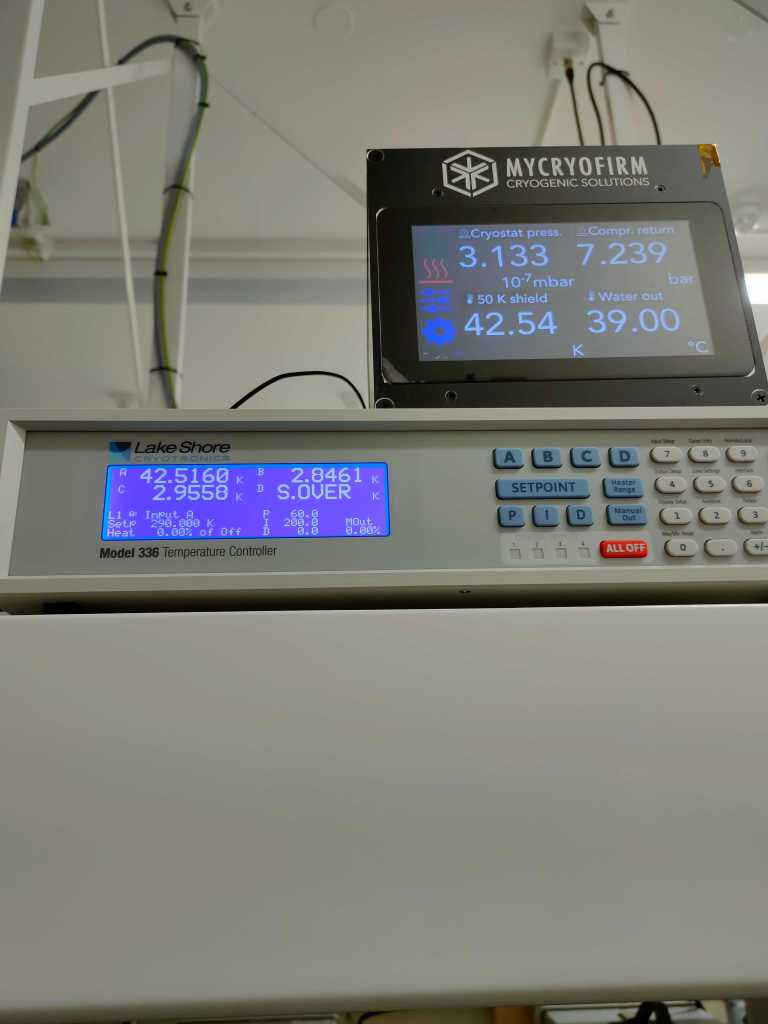

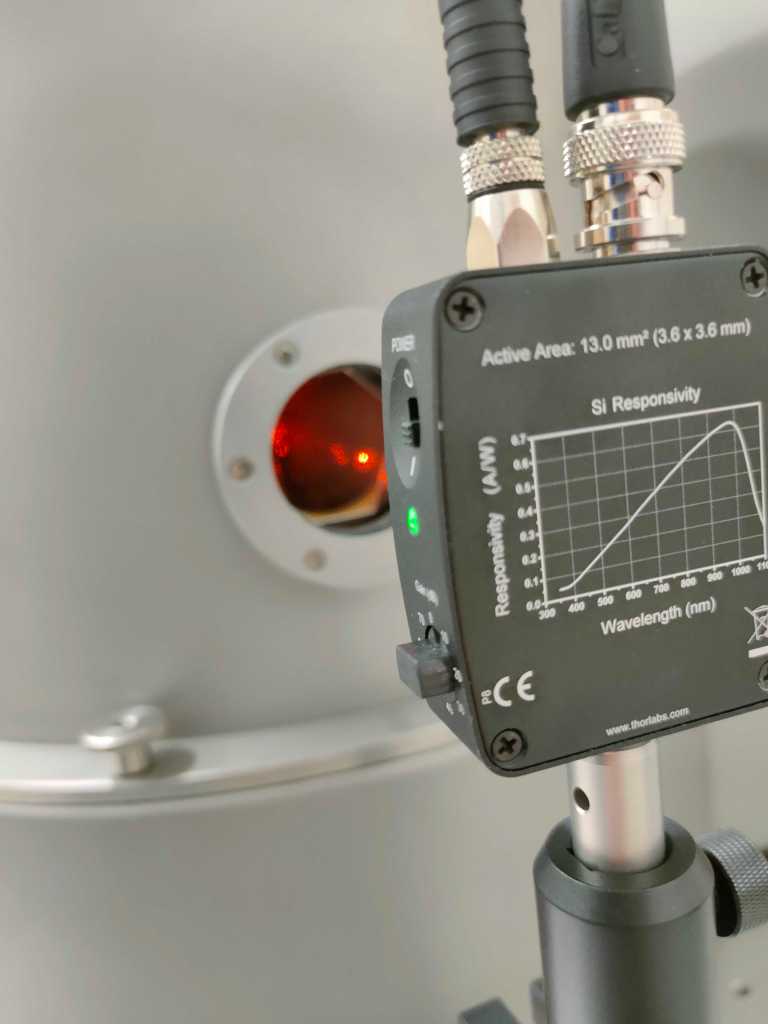
- 22 Aug 2023 – First PrYSO sample mounted and under vacuum! Great work from Ori and Vanderli to get the vacuum beyond an acceptable level! Awaiting cool down.


- 21 Jun 2023 – A long time between updates, but some success in the Solid-State Lab with our first generation of 606nm light! Produced via sum-frequency generation of 995nm and 1550nm in a nonlinear crystal in a fiber-coupled module. Currently performing to specification with around 100mW each of the input lasers to produce about 12mW of orange light. Next steps are to increase the input powers to get near half a Watt of orange light, while also building up our free-space orange optical set-up to probe the 606nm transition of praseodymium ions doped into crystalline hosts. Watch this space!
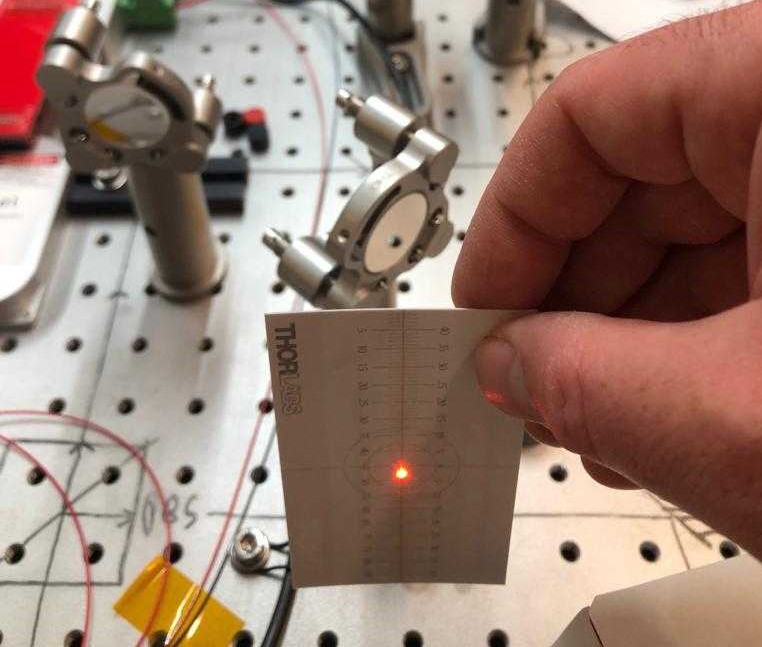
- 16 Mar 2023 – New Publication! Single-Photon-Compatible Telecommunications-Band Quantum Memory in a Hot Atomic Gas, Phys. Rev. Applied 19, L031005 (2023). “Tomorrow’s quantum Internet will be powered by light and will work over today’s telecommunication infrastructure, so we need low-noise, high-bandwidth, telecom-band quantum optical memory to enable scaling in the presence of loss and quantum operations. The authors have built such a device, using coherent two-photon absorption in warm rubidium vapor. This quantum memory stores gigahertz-bandwidth telecom-band light pulses with mean photon number less than one, and retrieves them with a signal-to-noise ratio exceeding 104. This makes possible ultrahigh-fidelity storage of single-photon qubits and is compatible with quantum-dot light sources, for hybridized quantum photonic networking.” Congratulations to all involved, including Zak from HQNL!
- 15 Mar 2023 – National Quantum Strategy published today – link here. “A 10-year vision and actions for the UK to be a leading quantum-enabled economy, recognising the importance of quantum technologies for the UK’s prosperity and security”.
- 07 Mar 2023 – New paper on the ArXiv! In collaboration with ICL and Stuttgart, we demonstrate the world’s first on-demand recall of quantum dot emission from an atomic quantum memory (based on hot rubidium vapour) all while operating near the telecommunication C-Band, and with a 1GHz bandwidth! We measured a total memory efficiency of 12.9(4)% and a signal-to-noise ratio of 18.2(6). The key to this successful demonstration is two-fold: (1) our telecom ORCA quantum memory is inherently low noise (measured to be 1.5(1)x10-8 noise photons per control pulse in the dot-memory demonstration) over the large bandwidth of 1 GHz; (2) The source was fabricated to have many quantum dots allowing to search for an ideal candidate emitting light near the 1529nm atomic transition of the memory, all while being integrated within a planar mirror cavity for enhanced emission. The second-order autocorrelation function of the input light is measured to be 0.325(8) and we infer the output to be 0.393(7) – both being in the quantum regime. Further optimisation is required of both the source and memory to observe quantum statistics on the output – watch this space!
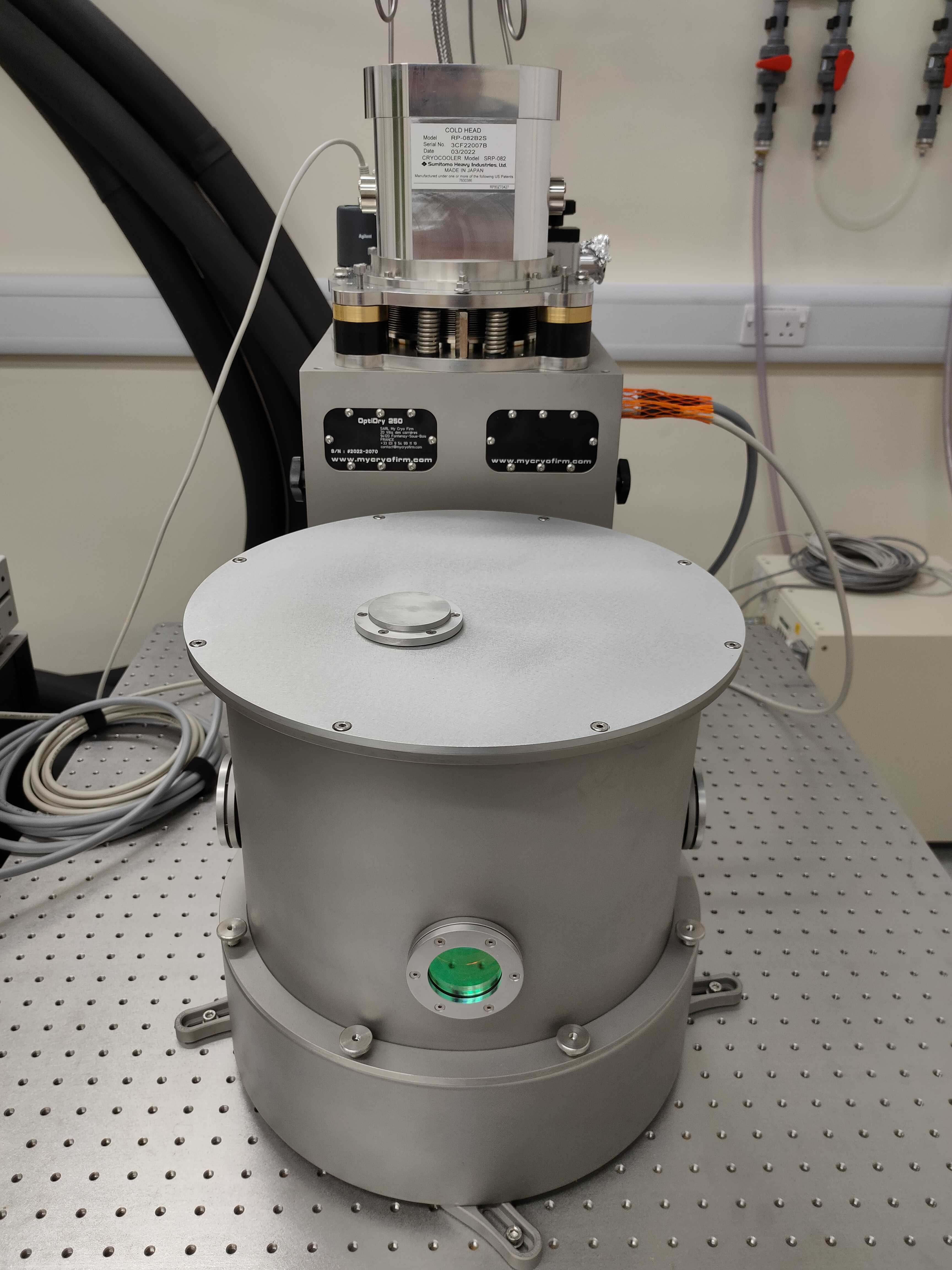
- 15 Nov 2022 – Our closed-cycle cryostat has arrived at HQNL! We have the OPTIDRY 250 from MyCryoFirm. First cool down got us to 2.6K. Looking forward to cryogenically-cooled rare-earth-ions and quantum dot experiments in the new year!


- 08 Nov 2022 – New paper on the ArXiv! In collaboration with ICL, we demonstrate a quantum memory in hot rubidium vapour that stores and retrieves weak coherent states of telecommunication C-Band light with a 1GHz bandwidth – https://arxiv.org/abs/2211.04415
- 07 Nov 2022 – HQNL continues still to grow as we welcome Vanderli Laurindo Jr! Vanderli joins as a Senior Research Assistant on Quantum Light Sources. Specifically, semiconductor quantum dot light sources for interfacing with our quantum memory devices. Welcome Vanderli!

- 03 October 2022 – HQNL continues to grow as we welcome Alice Christian-Edwards to the group! Alice joins as an MPhys Student (with Year in Experiment Research), working on passively rephasing of atomic coherences in warm Rb vapours. Welcome Alice!
- 01 August 2022 – HQNL welcomes Dr Ori Mor! Ori joins as a postdoctoral research fellow working on Solid-State Quantum Memories. Specifically, integrated approaches to cryogenically-cooled Rare-Earth-Ion-based devices. Welcome Ori!

- 27 July 2022 – Upgrades! Second optical table installed in the new lab courtesy of the crew at Redbourn Express Services. Slow but steady progress in this space so far as we gear up to expand research operations into cryogenically-cooled rare earth ions and quantum dots.

- 10 June 2022 – A long time between updates, but this is a worthy one to break the drought! HQNL’s first demonstration of two-photon ladder experiments! Preliminary data showing the transmission of a 780nm laser scanning over the D2 line, with and without the application of a counter-propagating telecom laser at approx. 1529nm, dressing the 5P3/2 state with the upper 4D5/2 state. Well done Zak!

- 01 Feburary 2022 – HQNL is now advertising a PhD and a PostDoc position! Both posts focus on utilizing solid-state rare-earth ion-doped platforms as integrated and efficient quantum memory devices. Join our team to build and exploit quantum networks with solid-state quantum memories and light sources, backed by £1.3M of UKRIFLF funding!
- 15 December 2021 – HQNL’s very first demonstration of velocity-selective optical pumping in a warm rubidium vapour! The two traces show the case for a diffrent optical pumping conditions, we are probing on the Rb D2 and performing velocity selective pumping on the D1. (blue) velocity selective pumping with a narrowband laser at a single frequency; (orange) velocity selective pumping with the same laser as before but with the laser modulated to have 100MHz frequency sidebands. Experiments performed by PhD stduent Zak Schofield. Well done Zak!

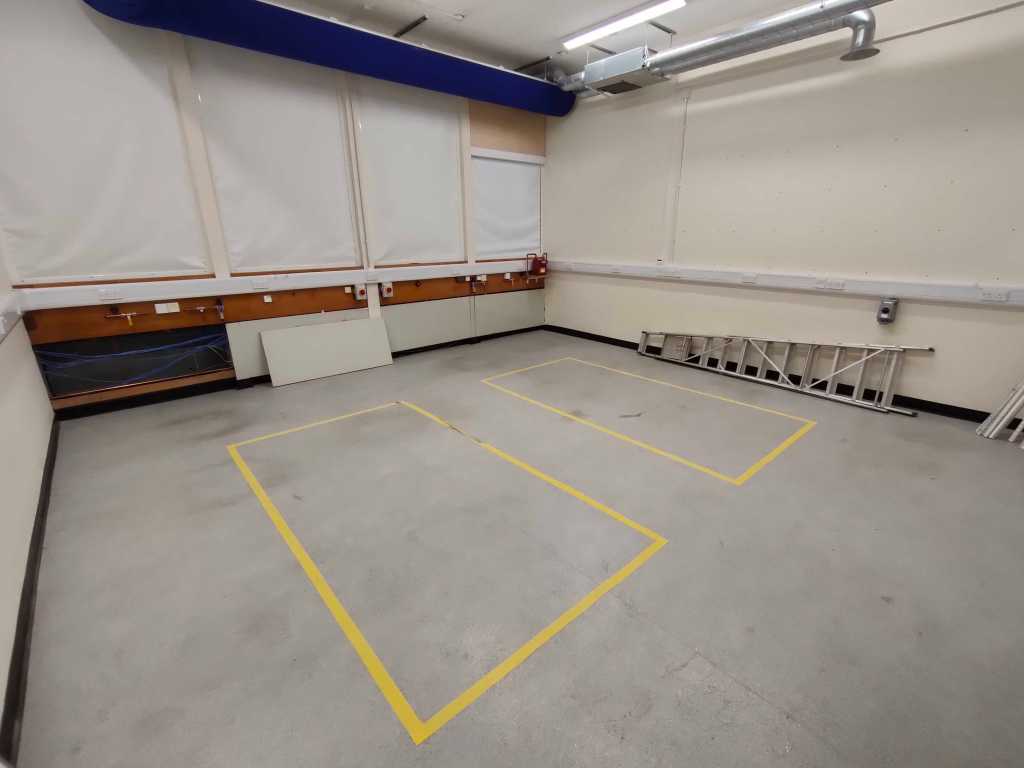
- 04 November 2021 – HQNL is expanding! With the FLF set to kick-off in March 2022, the race is on to renovate this new space to be fit for building and exploiting a high-performance light-matter quantum network. First step: group name on the door.

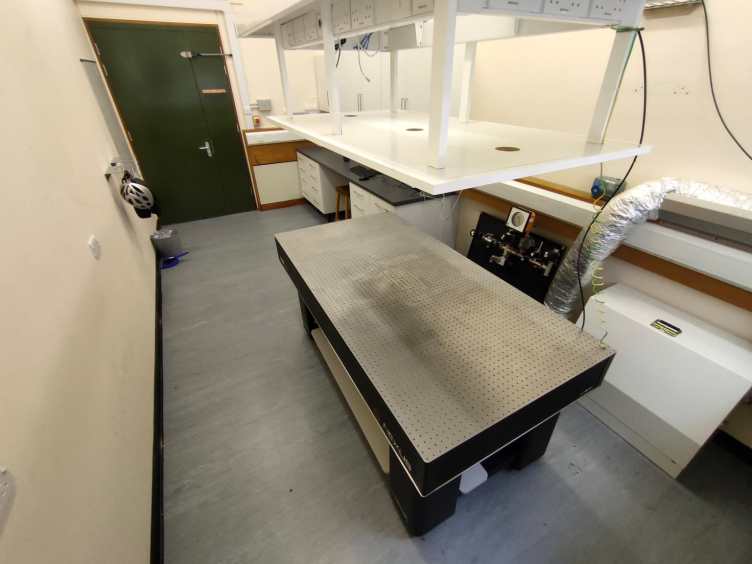
- 07 October 2021 – One year on and HQNL has evolved! Optical table occupied, experiments operational, name on office door, and soon a new lab space to move into in the new year to begin our UKRI FLF journey – watch this space!



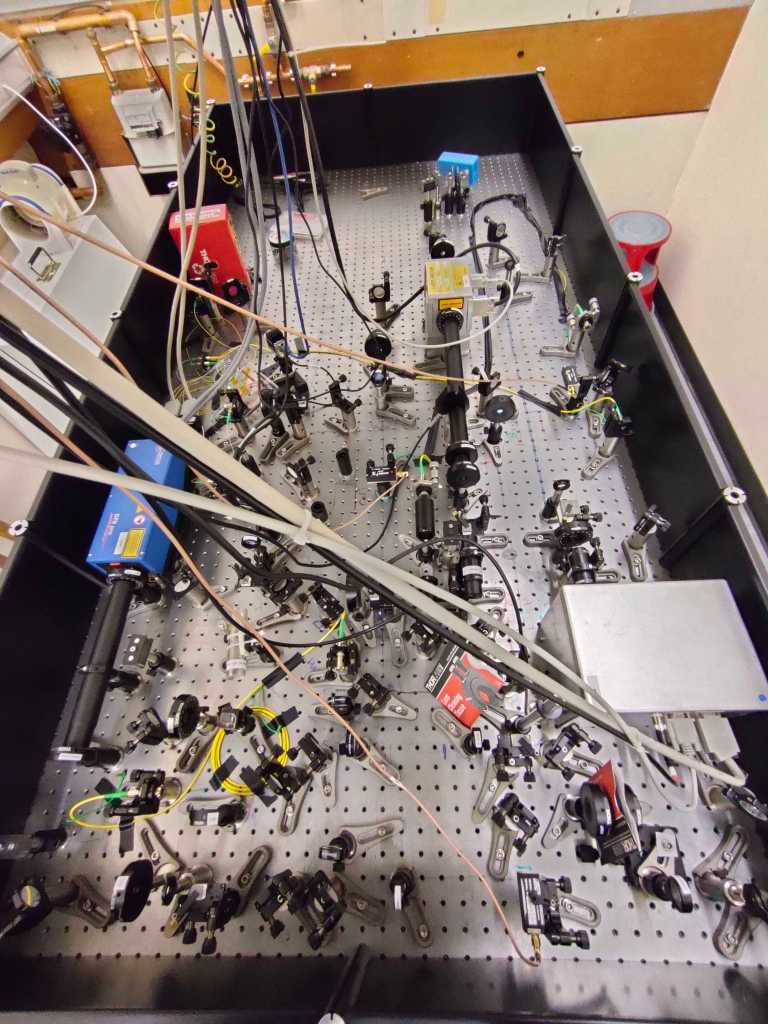

- 02 October 2021 – HQNL is now advertising for two postdoctoral researchers to join the team Early 2022! One position focuses on advancing quantum light sources in the telecoms band with compatibility to GHz-bandwidth quantum memories (link here). The other position focuses on building and exploiting telecom-compatible quantum optical memories for telecoms light-matter interfaces (link here). Come join our team to work on our UKRI-funded project ‘A High-Performance Light-Matter Quantum Network’. Spread the word!
- 08 September 2021 – Patrick has found success in securing a highly prestigious UKRI Future Leaders Fellowship. The project aims to build and exploit a High-Performance Light-Matter Quantum Network comprising ensemble-based quantum memories and single photons from quantum dots and non-linear crystals. There are great project partners onboard: ORCA Computing, Quandela and the FAST Group of Prof. Roberto Osellame., as well as strong mentors in Prof PGR Smith and Prof IA Walmsley. UKRI contribute approximately £1.3 million over 4 years to achieve our ambitious goals. Fantastic news for HQNL!
- 09 August 2021 – Patrick represents HQNL at Imperial College London with an online group seminar to the Quantum Measurement Lab led by Dr Michael Vanner. A pleasure to do so, looking forward to future visits and collaborations!
- 14 June 2021 – Two papers published in Optics Letters at the same time! [1] We demonstrate for the first time a GHz-bandwidth (~4 GHz) light storage in cryogenically cooled Pr:YSO. [2] We perform the atomic frequency comb protocol using a room-temperature platform – caesium vapour – a world’s first! *Update: [2] was later selected as an Editor’s Pick!

- 24 May 2021 – Ollie represents HQNL strongly at the QLM Seminar giving a talk about his MPhys Year of Experimental Physics project. A very nice talk and some decent results too! Well done Ollie!

- 05 May 2021 – HQNL does atomic state dressing! Preliminary evidence of Autler-Townes Splitting in warm Rb87 vapour. More characterisation to follow. Big effort from both Ollie and Zak to get to this point, well done!

- 12 April 2021 – New paper published in Physical Review A! We prepare the ground state of an ensemble of Caesium atoms in a way that depends on the what the velocity of a given atom is – velocity selective optical pumping! See here for more details.

- 12 March 2021 – HQNL involved in outreach activities! Zak giving a small tour of the lab for Future Photonics Hub. Well done Zak!
- 15 December 2020 – HQNL does optical pumping!

- 23 November 2020 – After some lab down time we now have air conditioning!

- 07 November 2020 – Two new papers on the arXiv! We demonstrate the atomic frequency comb quantum memory protocol in a room-temperature caesium vapour (link) using velocity selective optical pumping (link).
- 29 October 2020 – Progress: our first rubidium spectrum!

- 19 October 2020 – Zakary Schofield joins the Hybrid Quantum Networks Lab as a PhD student. Welcome to the team Zakary!
- 09 October 2020 – Operations ramping up with a few pieces of equipment arriving in HQNL!

- 05 October 2020 – Oliver Green joins the Hybrid Quantum Networks Lab to complete his MPhys Physics with a Year of Experimental Research. Welcome Oliver!
- 01 October 2020 – We have the keys to the lab! A clean slate to begin building and exploiting hybrid light-matter interactions for quantum networking!

- 01 July 2020 – The Hybrid Quantum Networks Lab is established.
 Hybrid Quantum Networks Lab